
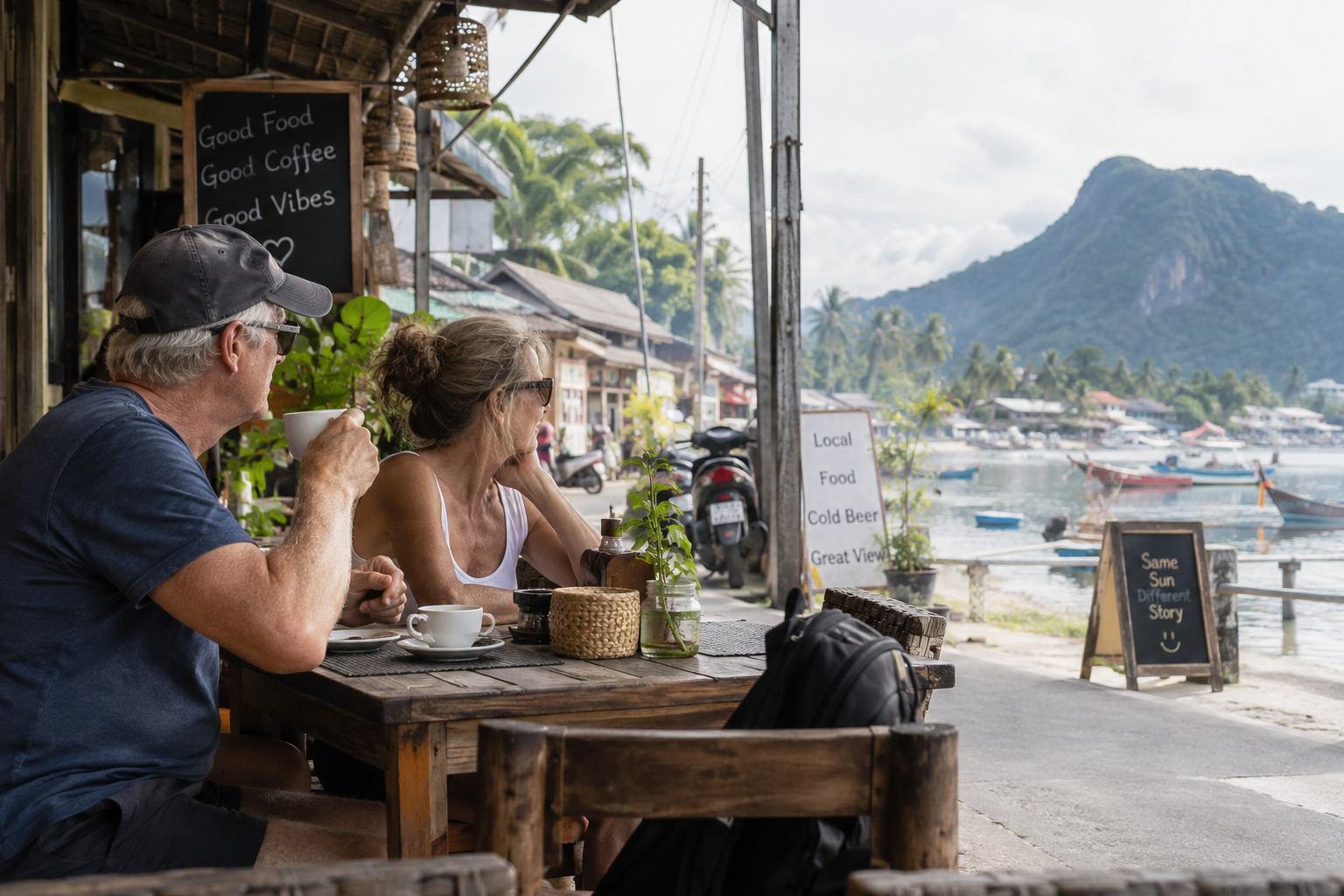
There’s no shortage of articles and social media posts explaining where Australians can retire more cheaply. Usually there’s sunshine, an inexpensive meal and someone declaring they’ve discovered the secret to a wonderful retirement. I understand the attraction, but I think there’s considerably more to the decision than finding somewhere your money goes further.
Having spent extensive periods of time in the Pacific islands and Southeast Asia, I’ve become accustomed to living outside Australia. These days, as I move towards retirement, I’m increasingly interested in how different places affect my health, wellbeing and general enjoyment of life.
For some Australians, retirement overseas might mean relocating permanently. For others, like me, it might mean dividing their time between Australia and somewhere abroad. Both offer opportunities, but there are some important things to think about before making the leap.
When the honeymoon is over
One thing I’ve learned about living overseas is that there’s often a honeymoon period. For the first three to six months, everything can seem wonderful. The weather is lovely, things appear remarkably cheap, people are welcoming and even a trip to the supermarket can be an interesting experience.
But eventually the novelty wears off and ordinary life takes over. Things don’t always work as efficiently as you’re accustomed to. The simplest task might require considerably more patience than it would back home. And maybe you can’t sleep because the karaoke goes on all night, or dogs never seem to be yapping, and then the power cuts out and you are trying to sleep in the tropical heat. You also might also discover that your social circle is smaller than you expected and that, however welcome you feel, you’re still a foreigner who stands out in the community.
None of this necessarily makes living overseas less enjoyable in terms scheme of things. It just means there’s a considerable difference between enjoying an extended holiday and establishing a life somewhere. I think it’s worth experiencing both before making any permanent decisions.
The attraction of a simpler life
When I’m overseas, particularly in the islands of the Philippines, I notice how much simpler my daily life becomes. I go to the gym, spend time in the ocean, explore places on my scooter and generally feel more relaxed. There’s less mental clutter and more freedom to decide how I spend my time. I seem to feel healthier and more motivated, which is surely an important consideration as we get older.
Returning to Australia is a different experience. Suddenly there are bills, responsibilities, regulations, appointments and an endless collection of things requiring attention. Everything seems considerably more expensive, and life becomes more complicated. Soem of these complications are necessary such as medical check ups, getting my tax done and so on.
Of course, those regulations and services provide benefits that we sometimes take for granted. Australia’s healthcare, public services, infrastructure and social protections are enormously valuable. I wouldn’t want to give them up simply because I enjoy a less complicated lifestyle elsewhere.
I also recognise that my experience overseas is a privileged one. Life may seem simpler to me partly because I have the financial security and freedom to enjoy it. That doesn’t mean life is necessarily easier for the people who live there permanently. You are stand out ,and this can come with frustrations of a different nature.
What happens to the life you’ve built in Australia?
This is where things become more complicated. What do you do with your Australian home? Sell it, rent it out or leave it empty? If you sell, where do you stay when you return to visit family and friends? If you keep it, can you afford the ongoing expenses of maintaining a home you’re only using part of the year?
There are also important financial considerations. How does living overseas affect your tax arrangements, superannuation, eligibility for the Age Pension and access to Australian concessions and benefits? The rules can vary depending on your circumstances and how long you’re away. These are questions worth investigating through Services Australia and the Australian Taxation Office, rather than assuming everything continues as before.
And then there’s family. My children are in Australia, as is my ageing mother. Being overseas means missing some of the ordinary moments that make up family life. Distance matters too. Can you get home on one flight, or does the journey involve several connections? Is there a significant time difference? How quickly could you return if something happened?
These aren’t necessarily reasons to remain in Australia, but they’re certainly reasons to think carefully about the arrangements you make.
Health matters, but so does living
As we get older, access to healthcare becomes increasingly important. Australia offers considerable security in this respect, although medical facilities in parts of Southeast Asia have improved significantly. Having spent time living on Pacific islands, I’m also aware of how limited medical services can be in more remote locations.
Medicare doesn’t cover treatment overseas, although Australia has reciprocal healthcare agreements with a limited number of countries. Appropriate medical insurance is essential, and the cost and availability of cover need careful consideration as we age.
But I find myself wondering how much of our retirement planning should be driven by what might go wrong. Naturally, we need to be sensible, but surely we should also consider where we feel happiest, healthiest and most stimulated.
For me, living overseas encourages a more active lifestyle and keeps me interested in the world around me. New experiences, different cultures and unfamiliar surroundings give me reasons to keep exploring and learning. I don’t want to organise the rest of my life entirely around the possibility of becoming unwell, although I don’t intend to ignore it either.
Finding the right balance
I don’t think there’s a simple answer to whether retiring overseas is a good idea. It depends on your finances, health, family circumstances, personal interests and willingness to adapt to a different way of life.
For the moment, dividing my time between Australia and overseas seems to suit me. It isn’t necessarily the cheapest arrangement, and maintaining connections with two places comes with its own complications. But it allows me to enjoy different experiences without giving up the security and relationships I’ve built in Australia.
I’m also conscious that what suits me now might not suit me in another five years. Perhaps that’s another reason not to make decisions that are difficult to reverse.
When I think about retirement, sure, cost of living is an important factor but more important is finding a way of living that keeps me healthy, curious, and looking forward to tomorrow. The challenge is balancing that freedom with the security and connections that remain important to me.
And perhaps the real test of retiring overseas isn’t how wonderful everything feels during those first few months, but whether you still enjoy the ordinary days once the honeymoon is over.
So, don’t go selling your house, cutting your ties and thinking she will be right. Test the waters and keep your powder dry.