
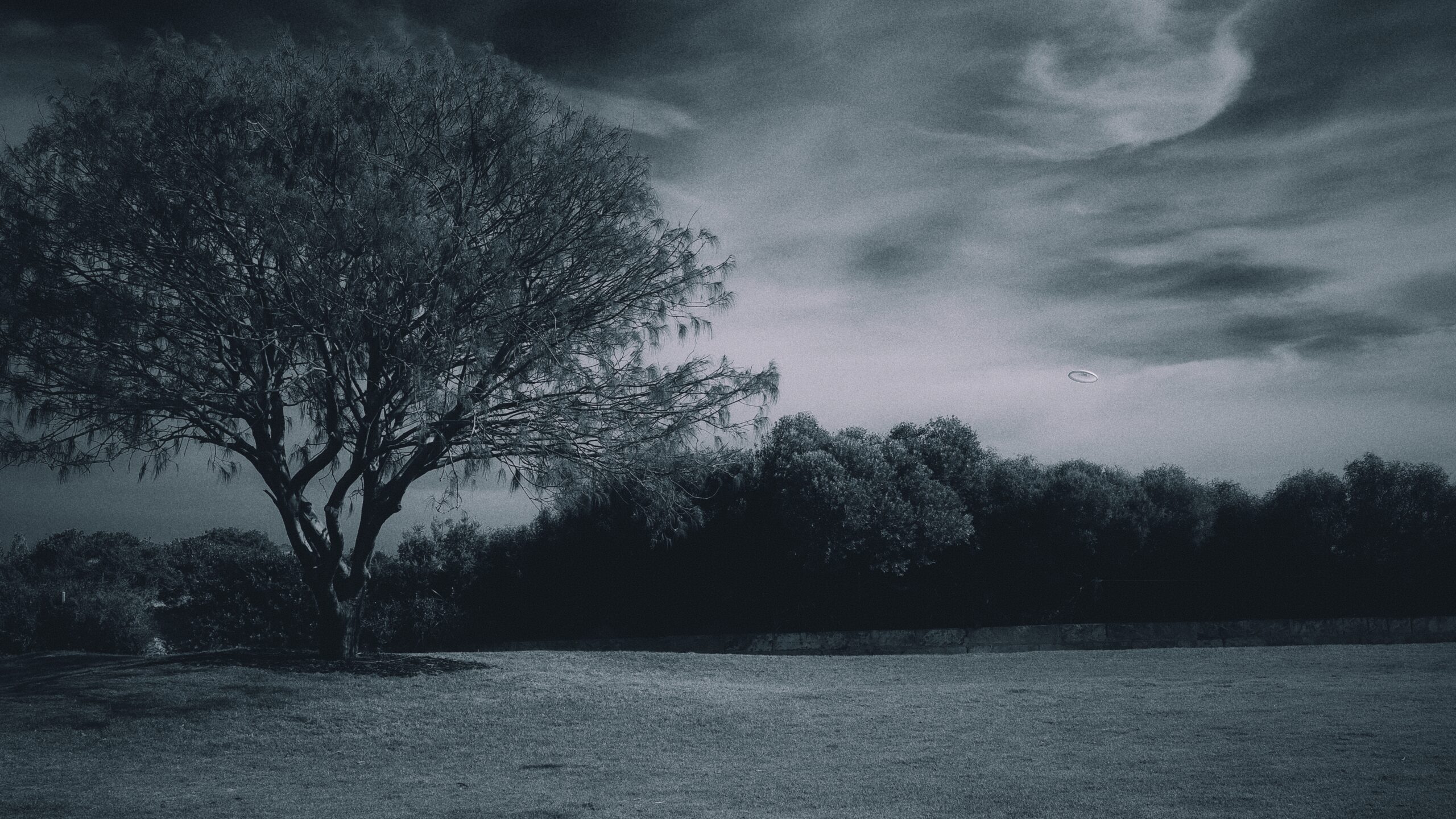
I have been thinking about aliens again. Perhaps it is because I have recently read Not for Disclosure, have been following Ross Coulthart, and have been paying more attention to UAPs and the hearings in the United States Congress. Former military and intelligence people are making extraordinary claims about non-human intelligence, recovered material and what governments may have kept from the public. I listen to some of this and find myself being pulled in. Then another part of me says, hang on. An extraordinary claim is still an extraordinary claim, regardless of who is making it.
I have always been interested in this stuff. Long before UAP became the more respectable term, there were UFOs, the pyramids, ancient civilisations, strange historical accounts and books such as Erich von Däniken’s Chariots of the Gods? I remember being fascinated by the possibility that some of the mysteries left behind by ancient cultures might have another explanation. Perhaps we had been visited before. Perhaps some of the gods described in ancient stories were something else. Maybe an advanced human civilisation existed in the distant past, or the supposed aliens are time travellers returning to Earth. My mind gets going, and before too long I am miles away from anything factual.
The problem is that it is easy to fill gaps in our knowledge with explanations that are exciting but unsupported. A mystery is not evidence of extraterrestrial life. The fact that I cannot explain how something happened does not mean aliens did it. At Giza, for example, archaeologists have uncovered substantial evidence of the settlements and working lives of the people who built the pyramids. Questions about particular construction methods do not erase that evidence. Human beings were remarkably inventive long before we had computers and YouTube tutorials. We should be careful that amazement at what ancient people achieved does not become an assumption that they could not possibly have achieved it themselves. Still, some of the feats of ancient civilisations are mind bending.
Somewhere during all of this pondering, I noticed something about myself. I thought maybe I actually want aliens to exist. Then I began wondering why I would want that and what exactly I was hoping for. We have no reason to assume another intelligent species would be friendly. If human history teaches us anything, it is that being technologically advanced and being morally decent do not necessarily go together. An intelligence capable of crossing interstellar distances might be wonderfully benevolent. It might also regard us with the same emotional investment I have in an ant wandering across my kitchen bench. Or worse.
So perhaps I do not particularly want aliens to arrive. What I want is to know whether they exist and whether any have already been here. Those are separate questions. Intelligent life could exist elsewhere without ever visiting Earth, and something unexplained in our skies does not establish that it came from another planet. I need to keep that distinction clear, particularly when an account is compelling enough to make me forget it.
Ask whether intelligent extraterrestrial life exists and, in reality, it either does or it does not. But I have three possible answers: yes, no, or I don’t know. The first two make a claim about the universe. The third describes the limits of my knowledge, and right now it is the only answer I can give with confidence. That does not mean the possibilities are equally likely. It means I cannot honestly claim to know which is true.
I find uncertainty frustrating. I like clarity, and I suspect most of us do. We want to know what happened, who is right and which explanation makes sense. We also like to put people into categories: believers and sceptics, religious and non-religious, left and right. Saying “I don’t know” can feel unsatisfactory when everyone seems to expect a definite position. Yet there is a difference between what is true, what I believe to be true and what I can demonstrate to be true. Those things are easily confused, particularly when I become emotionally invested in an answer.
God presents an interesting comparison. Ask me whether God exists and I face the same three possible answers: yes, no, or I don’t know. People have invested enormous amounts of time, money and commitment in religious belief, while disagreement about the existence of God continues. The strength of a belief can shape someone’s entire life without settling the question for somebody else.
Philosophers have spent centuries trying to reason through that question. The ontological argument is one of the more fascinating attempts because it tries to establish God’s existence through reasoning rather than physical observation. I am not going to solve the existence of God while discussing UFOs. That would be a fairly ambitious . What interests me is the underlying point: reality does not change according to the strength of our conviction about it.
If God exists, someone’s disbelief would not make God disappear. If God does not exist, the strength of someone’s belief would not establish otherwise. Likewise, if there is an intelligent civilisation orbiting a star five hundred light-years away, it exists whether I believe in it or not. The universe is under no obligation to wait until human beings reach a consensus.
That does not mean every explanation deserves equal weight. Someone who claims aliens are visiting Earth needs evidence for that particular claim. Being unconvinced by it does not require a person to declare that intelligent life exists nowhere else in the universe. I can remain open to life elsewhere while finding a particular account of alien visitation unpersuasive. Equally, I can take a witness seriously without accepting their interpretation of what they saw.
This is the distinction I keep returning to when I follow the disclosure debate. Congressional hearings in the USA provide an opportunity to present testimony and scrutinise claims, but holding a hearing does not establish that those claims are true. A military pilot reporting something they cannot identify has reported an unidentified object, not necessarily an alien spacecraft. A former intelligence official describing a secret programme has made a claim that needs to be examined. Their experience may give me a reason to listen carefully, but I still need to understand what they know and how they know it. Then hold on, isn’t the USA just one of the nations on the planet? What about all the other countries? Why are they not invest investigating any claims? Or are they?
Testimony at a hearing is evidence, but its value depends on what the person directly knows and what can be independently checked. Seeing an unusual object, examining a physical sample and hearing that somebody else has examined one are very different things.NASA says that it is not found credible evidence of extraterrestrial life or evidence that UAP’s are extraterrestrial. That does not identify every reported object. It does underline the gap between an unexplained observation and a demonstrated extraterrestrial explanation.
This is where I have to watch my own thinking. Stories accumulate: one person talks about recovered craft, another mentions unusual materials, and someone else claims information is being withheld. Videos appear, hearings are held, and officials give answers that sometimes seem carefully constructed to reveal as little as possible. After a while, it becomes tempting to think there is simply too much smoke for there not to be a fire somewhere.
But twenty people repeating versions of the same story do not necessarily provide twenty independent pieces of evidence. They may have heard from the same sources. Classified human technology could account for some observations. People can misinterpret what they see, rumours circulate, and memories change. Some people exaggerate and some people lie. Independent observations can strengthen a case, but repetition alone cannot tell me whether the original account was accurate.
And yet I cannot dismiss the whole subject either. Perhaps that is why I keep coming back to it. There are reports worth investigating and questions worth asking, but I have not seen publicly available evidence that settles the claim of extraterrestrial visitation. I find that frustrating, especially when people on either side seem so certain that the answer is obvious.
There may also be another reason I want an answer. Everyday technology has made it easy to expect an explanation for almost anything. I can pull a phone out of my pocket and identify a bird, translate a language, find a village on the other side of the planet, check tomorrow’s weather and ask an artificial intelligence to explain quantum physics while I am sitting on the toilet. That does not mean we have run out of mysteries. It means I have become accustomed to getting answers quickly. Extraterrestrial intelligence is a question that resists that convenience, and perhaps part of me enjoys being reminded of how much we still do not know.
There is also something appealing about the possibility that humanity is not the most advanced civilisation in existence. We take ourselves incredibly seriously. We fight over borders, religions, race, politics and pieces of land. We spend hours abusing strangers online because they voted for the wrong person or used the wrong pronoun. I sometimes wonder what confirmed contact with another civilisation would do to all of that. Perhaps very little. Knowing us, within a week we would probably have pro-alien and anti-alien political movements, alien conspiracy influencers and somebody selling T-shirts.
Still, the change in our understanding would be enormous. We would know that another technological civilisation existed. Religions, philosophies and scientific accounts of humanity’s place in the universe would have a major discovery to consider. We would still have to get on with our lives, but we would know something about our place in the universe that we had previously only imagined.
Then there is the part of the disclosure story that bothers me most: what if somebody already knows? I am not saying they do. But if a government, military organisation or private contractor possessed convincing evidence of an extraterrestrial civilisation, I would struggle with the idea that a small number of people should decide indefinitely that the rest of humanity was not entitled to know.
Governments keep secrets, and sometimes they have good reasons. I do not expect intelligence agencies to publish the location of every surveillance system or the details of every military capability because I happen to be curious. But confirmation of another civilisation would have significance far beyond national security. That knowledge would not belong to one government or one country. It would change humanity’s understanding of itself. Sensitive technical details might require protection, but if compelling evidence exists, I think the rest of us have a legitimate interest in knowing what it establishes.
Perhaps that is why belief alone no longer seems enough for me. It is easy to become convinced if I consume only material that confirms what I already hope is true. I also do not want to dismiss a claim simply because it sounds extraordinary or makes me uncomfortable. I want to understand the evidence and be willing to change my mind, including when the answer is less exciting than I had hoped.
If a strange object has a conventional explanation, show us how that explanation fits the observations. If an extraordinary allegation fails under examination, demonstrate where it fails. If credible evidence exists that another civilisation has been here, I want to see that too. I recognise that some cases may remain unresolved because the information needed to explain them simply does not exist. I may have to accept that uncertainty without turning it into either proof of aliens or proof that a witness invented everything.
For now, I do not know whether intelligent extraterrestrial life has visited Earth. I do not know whether governments possess convincing evidence they have withheld. I do not know whether the mysteries that have fascinated me since I first encountered the pyramids and Chariots of the Gods? will eventually have explanations far more ordinary than the ones I imagined. But I want to know, and some accounts continue to hold my attention despite all the questions I have about them. I am still fascinated by the Ariel School UFO incident in Ruwa, Zimbabwe, on 16 September 1994.