People may wonder why a semi retired bloke spends his time writing blog posts that nobody reads. In reality, nobody actually wonders about this. If they did, it would mean they had engaged with the posts and knew they existed. Most people don’t, so the question is unlikely to come up unless I raise it myself.
Still, it is a fair question. What is my motivation? After all, everyone is motivated by something. Am I trying to build a following, become popular or impose my views on other people? Am I hoping someone will discover The Silver Caravan and decide I have been unfairly overlooked? Maybe I will be invited onto a podcast to talk about my views. I don’t think so, although I am not going to pretend I would be offended if a few more people read my posts.
The same applies to my music. I have written songs for more than thirty years and recorded many of them at home using Logic Pro. Some are on SoundCloud, while others have spent years sitting in folders on a computer. Unless I send one to somebody and ask what they think, almost nobody hears it. When I do send one, they usually say something polite such as, “That’s pretty good,” which may be sincere or may simply mean they would prefer not to be sent another one.
So why do I keep writing and recording things nobody is waiting for and hardly anyone engages with? I guess the answer is that I like to create.
What happens while I am making something
Now, I am not a particularly good singer. I can play the guitar reasonably well and write a song, but I am under no illusion that a record producer is waiting for my next upload to SoundCloud. I am not sure I am a particularly good writer either. I can usually get an idea onto the page and make enough sense of it for someone else to follow, although the absence of readers means there is limited evidence either way.
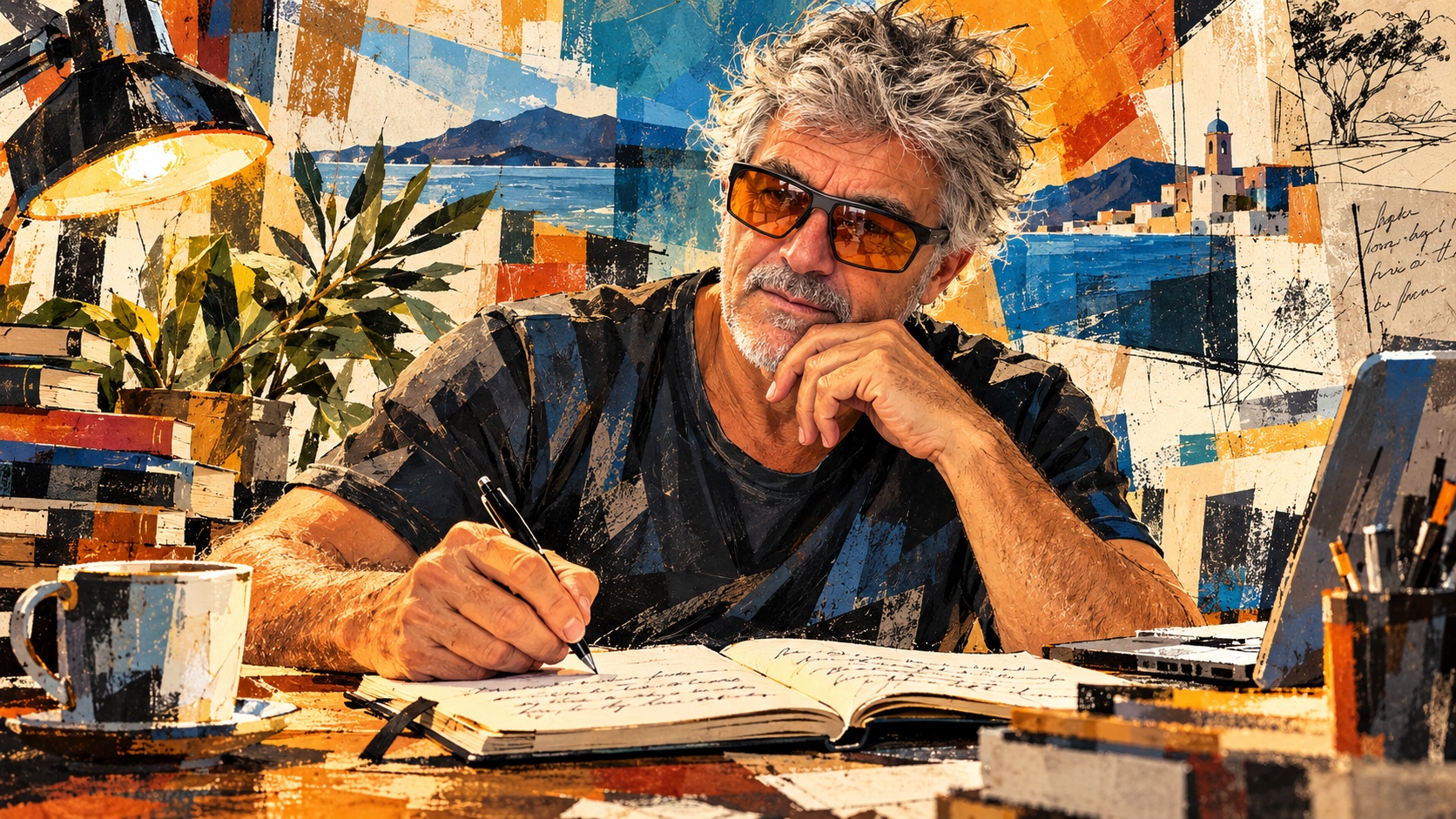
What I am good at is losing myself in the process. When I am writing something, recording a song or trying to work out why a guitar part does not sound the way I imagined it, the other noise in my head becomes quieter. I stop thinking about work, money, ageing, relationships, travel arrangements and all the other rubbish that normally competes for attention. For a while, I am concentrating on one thing. I zone out and become lost to the world. The house could be on fire and I would not notice until the flames had surrounded me.
That is probably my version of mindfulness. Some people would call the same behaviour rude and think I am a poor listener or simply uninterested. If I were sitting cross legged on the floor, following my breath while a small bell rang somewhere in the distance, no one would disturb me. So if I am trying to find the right word, chord or sound, or writing about how cats think about ethics, please leave me be. Sure, the method is different from meditation, but the effect is similar because my attention stops bouncing around and stays where I put it.
Sometimes I lose track of time entirely. People call that flow, but I do not need a theory to explain it. I know that I began working on something at two in the afternoon and suddenly it is dark, I have not eaten, and I have listened to the same sixteen bars so many times that I no longer know whether they are good or terrible. While I am inside that process, I am not worrying about whether anybody will eventually hear the result. Some people would consider this a complete waste of time. Tell that to a monk.
I could use the same hours scrolling through social media. I often do. The difference is that when I finish scrolling, I usually remember almost nothing and feel slightly irritated by people I have never met. When I finish writing or recording, I may not have produced anything remarkable, but I have used my mind in a way that feels worthwhile. I feel satisfied, although I often cannot sleep because the tune or piece of writing keeps repeating in my head. It takes a few hours for me to calm down.
The audience is not the point
I appreciate it when somebody reads something I have written or listens to one of my songs. I am not trying to claim that I am above praise or indifferent to other people’s reactions. If someone tells me that something connected with them, I am pleased. I just do not want their response to determine whether the time I spent creating it was worthwhile.
I particularly do not care if anyone has an issue with the voice or tone. I am more interested in whether they got the point. Short sighted, conservative office types will typically say that I should not give up my day job. I find that kind of feedback usually comes from someone who just does not get it.
Many people have become accustomed to measuring creative work through views, followers, likes, streams and comments. If the numbers are low, the work appears to have failed. That may make sense if the purpose is to sell something or build a career, but it does not explain why people draw, write, sing, play instruments or take photographs when they have no realistic expectation of attracting an audience. After all, creativity is like a relationship. Monetise it and you are having the wrong kind of relationship.
The process gives me something before anybody sees the result. I have followed an idea, made choices and worked out what I thought. I may also have discovered that the idea was not as intelligent as it seemed when it first entered my head, which is useful information to have. In the end, I may have created something that did not exist before, or nothing may result. The process, however, is never a waste of time.
Of course, I still want the finished thing to be as good as I can make it. Saying that the process matters does not mean every piece of rubbish becomes valuable because I enjoyed producing it. I revise the writing, rerecord parts of songs and sometimes abandon things that do not work. The difference is that I am not relying on public attention to justify having attempted them. I am the judge, jury and executioner of my own work. Often, what is in my head is much better than what I am capable of putting into words. I am not a Wall Street Journal editor or an Abbey Road sound engineer, so what you get is what it is.
The songs are part of my story
My recordings have gradually become a personal archive. The songs contain pieces of relationships, experiences, observations and emotions from different periods of my life. I usually remember the circumstances in which I wrote them, but I did not always understand what I was really writing about at the time.
Years later, I can listen to a song and recognise something that was sitting underneath the words. I may have thought I was writing about another person when I was actually writing about myself, or thought I was angry when I was probably hurt. The subconscious has a way of slipping things into a song while the conscious mind is occupied with trying to find a rhyme.
I sometimes listen to my own music at the gym. That sounds rather self indulgent and up myself. You know, like a rooster strutting on a treadmill and admiring its own genius. The reality is less impressive. I listen because the songs are familiar and because they contain parts of my life. They remind me of people, places and versions of myself that no longer exist in quite the same way. Okay, I confess, I do sometimes admire a particular chorus and mumble “genius” under my breath.
That familiarity is comforting. I do not think my songs are better than everything else available, and I am aware that the world has managed reasonably well without hearing most of them. They matter to me because they are mine and because I know what sits behind them.
Sometimes I use an AI music tool to improve the production of an old recording. I know some people think it is sacrilege. I am not handing over the lyrics, melody or original arrangement. I have already written and recorded the song. The technology is helping with a part of the process that a professional producer and recording engineer might otherwise do, and I cannot justify paying thousands of dollars to professionally produce music that may be heard by six people. Besides, I am getting old and want to capture those ideas using technology that can present my compositions in the best possible way.
That is really all I want to say about AI here. It is a tool I sometimes use to improve recordings that were held back by my production skills. The article is not about whether artificial intelligence can create art. It is about why I keep creating things even when almost nobody is paying attention.
The blog is another kind of archive
The blog has started to serve a similar purpose. I must admit that I do not particularly enjoy rereading many of my posts. I often find them boring, which is not a particularly strong recommendation for anyone considering visiting the website. I am also a lazy reader, which probably does not help.
Perhaps I find them boring because I already know what I thought. There is no surprise in the argument and no suspense about how the article ends. Sometimes I read something I wrote a year ago and wonder why it took me so many paragraphs to make a fairly simple point.
I leave the posts there anyway. Each one records what was going through my mind on a particular day, during a particular month, in a particular year of my life. Some may seem naive later. Some will repeat things I have said elsewhere, and some may be complete rubbish. That does not mean they have no place in the record.
I am not writing the final word on anything. I am recording what I thought at the time. If I later change my mind, that is also part of the story. A personal archive should probably contain the contradictions, false starts and things that did not age particularly well, because that is what a life actually looks like.
My website, songs and photographs have become a loose collection of where I have been and what occupied my attention. It is not organised with the care of a national archive, and no historian is standing by waiting to catalogue it. But when I look through it, I can see the journey of my own thoughts and interests.
I do not want another career
I am retiring, and there is a growing tendency to turn every interest into something that needs an audience, a business plan or a personal brand. You take photographs, so perhaps you should become a travel photographer. You make videos, so you need a YouTube strategy. You write a few songs, and suddenly somebody wants to explain how to improve your streaming numbers. I am not a social media star or an influencer and never will be.
I have spent enough of my life producing things for other people, meeting deadlines and worrying about whether the result satisfied whoever was paying for it. I do not want my creative interests to become another job with performance measures attached.
My Facebook and Instagram pages are connected to the website, and hardly anyone looks at them. I am lucky if I get one like on The Silver Caravan Facebook page. It is kind of nice. It simply exists as a quiet place for my own expression. So I do not really care if no one reads anything. That does not mean I am ungrateful when somebody responds. It means that a lack of likes is not a problem I feel any need to solve.
I am not trying to establish myself as a writer, musician, photographer or content creator. Those labels may be useful for people building careers, but I have already had a career. What I am doing now is finding things that hold my attention, give some shape to my days and allow me to explore parts of myself that work did not always leave much room for.
Perhaps video is next
The Silver Caravan has a YouTube page, and some of my music is already there, but I have thought about adding vlogs. I do not particularly enjoy filming myself or editing the result. When I watch the footage, I think I look old, do not speak especially well and come across as slightly awkward. You can see my rather sparse channel here – @thesilvercaravan. I will post something soon.
Video might become another form of journalling. It could record where I was, what I was doing and what I happened to be thinking at this particular stage of my life. It does not have to compete with people who have perfect lighting, excellent teeth and an alarming enthusiasm for telling strangers to subscribe. I have all the gear, so it is just a case of doing it.
I could make a few videos and see whether I enjoy making them. They may be roughly edited and watched by almost nobody, but that would place them in familiar company. The important question is not whether I can build a channel. It is whether the process holds my attention and gives me something I enjoy working on.
While I am still here
I am not pretending that any of this will become a permanent legacy. One day the website will disappear. The hosting bill will stop being paid, the software will fail or somebody will decide there is no reason to keep it going. Hard drives fail, online platforms close and digital files can vanish remarkably easily. I will disappear as well, which makes worrying about my long term engagement figures seem slightly ridiculous. The fact that something will not exist forever does not mean it has no value while it is happening.
So why do I write blog posts nobody reads and record songs nobody hears? Because the process gives my mind somewhere worthwhile to go. It absorbs me, quietens some of the noise and leaves me with a record of what I was thinking or feeling at that point in my life. An audience is welcome, but it is not required. While I still enjoy making things, I will keep making them. That is probably the whole explanation.